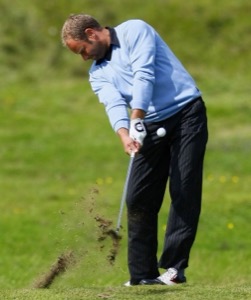
Ball speed, carry distance and clubhead speed are the launch monitor numbers you can trust from a handful of shots. Spin and smash factor move around far more, and the club numbers are measured less accurately than the ball, so read them as trends over many shots rather than reacting to every swing.
Put a decent amateur in a simulator bay for an hour and I can usually tell you what they will do. They will hit driver, they will look at the screen, and within about ten shots the conversation will be about spin.
It is the wrong number to build a session around, and not because spin does not matter. It is the wrong number because it is the one you can trust least.
Which numbers hold up
Reliability studies report how consistently a device measures the same thing across repeated shots, and the spread is enormous. On the same machine, some numbers score close to perfect while others score close to useless.
The ones that hold up are clubhead speed, ball speed and carry distance. Take those seriously from a handful of shots.
Spin sits right at the bottom. In one study of Trackman 4, with good golfers hitting driver indoors, spin rate scored between 0.02 and 0.60 on a scale where 1.0 is perfect consistency. The bottom of that range is, in plain terms, close to noise. So when your spin reads 3,100 on one drive and 2,400 on the next, a real part of that difference is the measurement rather than the swing, and you cannot tell which from where you are standing.
Smash factor is the one that surprises people, including me. Because it is calculated from two other numbers it inherits both of their errors, and the same study found it drifted systematically between sessions. It is fine for comparing shots inside one session. It is not something to track week to week.
That does not make spin worthless. It makes it a number to read as a trend across a lot of shots rather than a dial to adjust between swings. Watching it flicker and changing your swing in response is how people leave a session worse than they arrived.
The Foresight versus Trackman argument
We have both a Foresight GCHawk and a Trackman in the building, so I get asked which one is right when they disagree.
The honest answer is that both are good, with a caveat. The one independent study I know of that compared launch monitors against a laboratory reference, using earlier models of both, found that radar and camera based systems measured the ball well. The club measurements, path and attack angle among them, agreed less closely. The short version: what happens to the ball is measured well, what the club did less so.
They measure differently. Radar tracks the ball and club through space. Camera based systems photograph the ball at impact and calculate from there. Two accurate instruments measuring by different methods will not produce identical numbers, and that is not a fault in either of them.
Almost every "which is more accurate" comparison you will find online traces back to retailer or affiliate sites rather than independent testing. I would treat those the way you would treat a shop telling you which brand of clubs is best.
Where your strokes actually go
Here is the part that changes how people practise.
Mark Broadie's strokes gained work is worth explaining, because it changed how golf statistics are done. Rather than counting putts or fairways, it compares every shot you hit against what a benchmark player would typically score from that same spot, so you can see exactly which part of your game is costing you and how much. Applied to amateurs, it shows where they lose shots against better players. The largest leak is not driving. It is the shots from more than 100 yards out, approach shots above all, and the gap widens as handicap rises.
Meanwhile, in a simulator bay, the club that comes out of the bag first is almost always the driver.
I understand why. Driver is the most fun club to hit indoors and ball speed is the most satisfying number on the screen. But if you are a sixteen handicapper and you want to shoot lower scores, the hour would be better spent working out why your 150 yard shot finishes 20 feet short and right more often than not.
A useful test of a practice session: could you say afterwards how far you actually carry each iron? Most golfers cannot, and most golfers are losing more strokes on approach shots than anywhere else on the course.
The attack angle myth
One more, since it comes up every week. Golfers arrive wanting to shallow their attack angle, because somewhere they have picked up that shallower is better.
The problem with that is that attack angle only means something read alongside low point, which is where the club actually reaches the bottom of its arc relative to the ball. Chasing a shallower number on its own can move you away from a good strike rather than towards one.
That is the general problem with launch monitor data in the wrong hands. Every number is related to several others, and optimising any single one in isolation usually costs you somewhere else.
Using a bay properly
None of this is an argument against practising indoors. It is an argument for knowing which numbers deserve your attention.
If you want a straight answer on what your numbers actually say, that is what an assessment is for. We look at the metrics that are reliable, put your gapping through the bag on paper, and tell you where your strokes are genuinely going rather than where it feels like they are going.