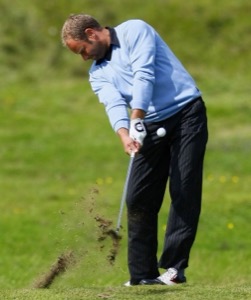
If swing thoughts have not stopped you coming over the top, the cause is often physical rather than technical. When your lead hip or upper back cannot rotate far enough, your body gets the club to the ball the only way it can, by throwing the arms and shoulders out and over. The way to stop it is to find out which you have, a habit or a restriction, before spending another season on drills.
Every coach in the country has said it to somebody this week. Drop the club into the slot. Feel like you are swinging out to the right of the target. Keep your back to the target for longer.
If that advice had worked on you, you would not be reading this. You have had the lesson, you have felt it once on the range, and by the third hole on Saturday the same shot was back. That is not a discipline problem and it is not a talent problem. In a lot of cases it is a physical one, and no amount of repetition fixes a movement your body will not let you make.
What "over the top" actually means
Strip away the jargon and it is one thing: the club is travelling from out to in through impact. The clubhead is moving left of the target line, relative to where it is pointing, and the result is a pull, a slice, or the pull-slice that starts left and finishes in the trees on the right.
The useful part is that this is measurable. On Trackman we look at club path directly rather than working backwards from where the ball finished.
One honest caveat, because it matters. Launch monitors measure the club less accurately than the ball. In one independent test of earlier models against a laboratory reference, fewer than half of the radar's club path readings landed within a degree of the true value, so I would not hang a diagnosis on a single reading. Across a run of shots, though, it will show you which way your path runs. That matters more than it sounds, because plenty of golfers who are certain they come over the top are working from feel alone, and a fair number of them have it the wrong way round.
So the first job is not to fix anything. It is to find out whether the thing you have been trying to fix is the thing that is happening.
Why the swing thought keeps failing
Assume the path is genuinely out to in. The next question is the one that usually gets skipped.
To get the club to approach from the inside, your body has to do a few specific things. It has to rotate the pelvis towards the target while the upper body stays back for a moment. It needs the lead hip to rotate internally as you turn into it. And it needs enough rotation through the upper back, the thoracic spine, to let the shoulders turn without dragging the arms out and around with them.
If any of those are restricted, your body will still find a way to get the club to the ball. It always does. But the way it finds is to throw the arms and shoulders out and over, because that route does not require the rotation you do not have.
This is the bit that gets missed. The over-the-top move is often not the fault. It is the compensation for the fault. Coaching the compensation while leaving the restriction in place is why the lesson does not survive the weekend.
How we tell the two apart
This is where having a clinician in the same building, Stride Clinics next door here in Warwick, changes what we can do. It is the reason I work the way I do now.
We screen the movements the swing actually needs. Lead hip internal rotation. Thoracic rotation. Whether you can separate your upper body from your lower body at all when you are standing still and nobody has handed you a driver.
I want to be careful about what that screen does and does not tell you. It is not a crystal ball: a 2023 study that followed 41 elite golfers found screening did not pick out the ones who went on to develop back pain. What it does do is tell us what your body can currently do. If you cannot rotate your lead hip on a treatment table with no club in your hands and no ball to hit, you are certainly not going to do it at 90 miles an hour under pressure on the first tee.
Alongside that we film the swing on the high-speed cameras and look at the pressure trace on the BodiTrak mat, which shows how your weight moves through the swing and when. That is pressure and weight transfer rather than the full force picture a lab force plate would give you, and it is worth being straight about the difference, but it tells us plenty about sequencing.
Put the three together and you get an answer rather than an opinion. Either your body can make the move and you have a genuine technical habit, in which case coaching it is exactly the right call and it will stick. Or it cannot, in which case we have been asking you to do something impossible and we should stop.
What happens when it is physical
If it is a restriction, the work changes completely. It stops being about swing thoughts and becomes about restoring the rotation, then rebuilding the movement pattern on top of it once the range of motion is actually there.
That is not a quick fix and I would not sell it as one. But it is a real one, and the difference is that it holds. When the body can do the movement, the swing thought suddenly works, because you are no longer fighting yourself.
The golfers who get frustrated with lessons are very often the ones who were given good coaching for a problem they did not have.
Where to start
If you have been fighting the same shot shape for more than a season, the useful next step is not another lesson on the same thing. It is finding out which of the two problems you have got.
That is what an assessment is for. We measure the path so we know what is genuinely happening, screen the movements the swing needs so we know what your body will allow, and then decide together whether this is a coaching job, a physical job, or both.
It is a more honest starting point than another bucket of balls and another feel.