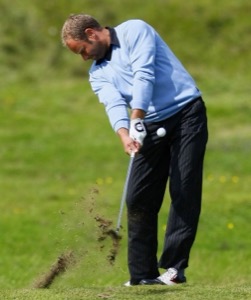
Golf in Warwickshire does not stop for winter. Most rounds still count for handicap, the county's winter team matchplay carries on, and the months to March are the best time of year to build the power that adds distance. The two things to watch are temporary greens, which decide whether a score stands, and winter mats, which are behind a lot of the sore wrists and elbows we see by February.
You will also hear that winter is when you rebuild your swing. Whether that is true for you depends on things worth being specific about, so let me be specific.
What still counts
Start with the question that causes an argument in every clubhouse in the county around December.
Under the World Handicap System guidance, a round remains acceptable for handicap purposes with no more than two temporary greens on an eighteen hole course, or one on a nine hole course. Beyond that it does not count, however well you played. So it is worth knowing what your club is doing to the course before you decide whether a score is going to stand, rather than finding out afterwards.
Clubs vary a lot in how quickly they go to temporaries and mats. Some hold out. Some protect the greens at the first hard frost. Ask your greenkeeper what the plan is rather than assuming it will be the same as last year.
County golf does not stop
There is a common idea that competitive golf in Warwickshire pauses until spring. It does not.
The county runs winter golf through the colder months, and it is worth understanding how it is organised, because it catches people out. The men's Warwickshire Cup is a winter matchplay competition between club teams, so it is played for your club rather than entered as an individual.
So if you fancy playing competitive golf this winter, you do not enter yourself. You talk to your club captain or your team organiser and get into the side. That is a different conversation from the one most people expect, and it usually needs to happen earlier than they expect too.
What winter actually does to your golf
The cold costs you distance and there is nothing clever to be done about it. The ball does not compress the same, the air is denser, you are wearing more layers and turning less. Expect to be shorter and pick clubs accordingly rather than fighting it every hole.
Mats are the bigger issue, and this is the one I would actually worry about.
On turf, a steep angle of attack gets forgiven. The club digs, you take a divot, you get away with it. On a mat the club cannot dig, so a steep strike meets something that does not give. Do that for three months and it goes one of two ways. Either your body absorbs it, which is where a lot of sore lead wrists and cases of golfer's elbow come from by February. Or you unconsciously change your action to a flatter, scoopier one that the mat tolerates, and you arrive in April wondering where your divots went.
Both are avoidable. Neither is obvious while it is happening, which is why it is worth knowing before the mats come out rather than in February.
What is actually worth training
Here is where I will give you a straight answer rather than a menu.
The strongest evidence we have on what physically drives clubhead speed points at power, specifically the ability to put force into the ground. A 2024 review pooling twenty studies found that quality sat well clear of the alternatives, and that flexibility, which is what most golfers assume they need, showed no meaningful relationship with speed at all.
That matters for winter planning because power responds to months of consistent work. It is the one thing on the list with real runway in it. You cannot meaningfully build it in a fortnight in March, and you have four months sitting in front of you where you are playing less anyway.
If you would like a structured start, Luke Northwood's Fit 4 Golf programme runs on Wednesday evenings through November: four weeks covering a movement screen, mobility, warm-ups, and a speed and power retest.
Speed sticks come up constantly and I have no quarrel with them. But the numbers you see quoted for them come mostly from manufacturers rather than independent trials, whereas the case for strength work rests on considerably firmer ground. If you are choosing one, choose the one with the evidence behind it.
On rebuilding your swing
Now the thing I actually get asked about.
Rebuilding a swing over winter works. I have seen it work many times. But it works under four conditions, and it is worth saying plainly what they are, because most people who attempt it have one or two of them rather than four.
You need a real reason to change, not one bad round in September. You need enough sessions to build the new pattern rather than just understand it, which realistically means something close to weekly through the whole window. You need somewhere the ball flight is measured, because a change you cannot see the effect of is a change you will quietly abandon in February. And you need to accept being worse before you are better, at the exact time of year when there is least evidence you are improving.
Have all four and winter is absolutely the right time. I would encourage it.
Have none of them, and a rebuild attempted across three sessions in January is how golfers arrive in spring worse than they finished in autumn. If that is you, spend the winter learning your carry distances properly and sharpening your short game. Neither requires you to relearn anything, and both will save you shots in April.
A plan you could actually follow
Keep playing, including for your club side if you can get in it, because golf in bad conditions teaches you things a range never will. Put your real effort into physical work, because that is where the evidence is strongest and the returns last longest. Use indoor time to measure rather than to hit driver, and know your numbers by spring. And if you are going to make a technical change, commit to it properly or leave it alone.
If you want to know which of those matters most for you specifically, that is what an assessment sorts out. We measure what your swing is doing and what your body can currently do, then you spend the winter working on the thing that will actually change your golf.